
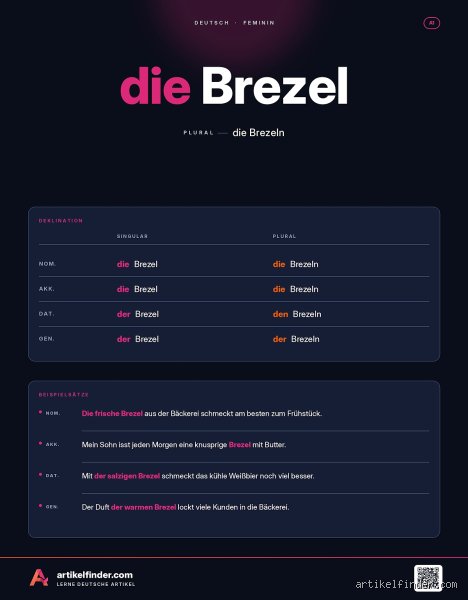
Die Frage nach dem richtigen Artikel für das Wort „Brezel“ beschäftigt Sprachbegeisterte, Dialektsprecher und Grammatik-Fans gleichermaßen. Ob im Biergarten, beim sonntäglichen Frühstücken oder in der Bäckerei – dieses traditionsreiche Gebäck ist aus dem Alltag kaum wegzudenken, doch beim grammatikalischen Begleiter scheiden sich oft die Geister.
Die Grammatik im Überblick
Die Brezel (im Nominativ Singular) ist die in weiten Teilen Deutschlands, insbesondere im Norden, Westen und in der Mitte, absolut vorherrschende und standardsprachliche Form. Der weibliche Artikel „die“ dominiert hier und ist auch im Duden als Erstnennung verzeichnet.
Nominativ: die Brezel (Plural: die Brezeln)
Genitiv: der Brezel (Plural: der Brezeln)
Dativ: der Brezel (Plural: den Brezeln)
Akkusativ: die Brezel (Plural: die Brezeln)
Regional gibt es jedoch faszinierende Abweichungen, die tief
When designing and deploying AI-driven systems, applications, and agentic workflows, certain approaches look brilliant on a whiteboard but quickly cause failures in production. These are known as AI anti-patterns.
1. The "God Prompt" (Monolith Brain)
What it is: Trying to handle every task, constraint, format, and edge case inside a single, massive system prompt.
Why it fails: Context is consumed by rigid instructions instead of user content, instructions start conflicting with each other, and small prompt tweaks cause unpredictable regressions across unrelated features.
The Fix: Decompose complexity. Use a router model or deterministic code to direct tasks to specialized, narrow prompts and smaller models.
2. Prompt-as-Program (No Contracts)
What it is: Relying on natural language text inside prompts to act as strict data schemas, formatting rules, or API contracts without code-level validation.
Why it fails: Models experience prompt drift, misinterpret minor wording shifts, or occasionally forget formatting constraints under long contexts.
The Fix: Enforce programmatic contracts (such as JSON schemas, structured output parsing, and strict type validation) rather than hoping the model obeys text rules.
3. Autonomous Tools With No Permissions ("The Loaded Gun")
What it is: Giving an AI agent unconstrained write/execute tools (e.g., database deletions, financial transactions, or infrastructure changes) with direct execution power.
Why it fails: Prompt injection, user error, or model hallucinations can instantly turn an assistant into an accidental destructive operator.
The Fix: Implement strict permission layers—separate read from write tools, enforce scoped credentials, and require explicit human-in-the-loop confirmation gates for irreversible actions.
4. Unbounded Agent Loops
What it is: Allowing an agentic loop to plan, execute tool calls, and iterate indefinitely until it decides it is "done".
Why it fails: The agent can get stuck repeating the same failed tool call or enter an infinite loop of reasoning, leading to runaway API costs and frozen user threads.
The Fix: Set hard deterministic boundaries, including maximum tool-call limits, max wall-clock time, loop detection (same tool + same arguments), and clear fallback stop conditions.
5. Overstuffed Context ("More Is Safer")
What it is: Stuffing entire codebases, long chat histories, or uncurated reference documentation into the context window on every request.
Why it fails: It triggers the "lost in the middle" phenomenon, increases hallucination rates, scales token costs exponentially, and dilutes the signal with noise.
The Fix: Exercise context discipline—use precise retrieval with tight top-K filtering, reranking, and periodic history summarization into compact state objects.
6. Treating Tool Output as Absolute Truth
What it is: Blindly passing raw API search responses, scraped text, or database queries back into the model's decision path without validation or sanitization.
Why it fails: Malicious data injection or messy upstream tool errors are treated as factual gospel by the model, resulting in confident, cascading downstream failures.
The Fix: Sanitize, schema-validate, and structure all tool outputs before feeding them back into the model loop.
💡 Wichtige Punkte
- Welcher Artikel kommt vor Brezel? - Brezel, schweizerisch auch Bretzel, die oder das.
- Welcher Artikel steht vor Brezel? - Standardsprachlich gilt nur das Femininum die Brezel als korrekt.
- Welcher Artikel kommt vor Silvester? - Substantiv, m, nSingular 1PluralNominativder Silvesterdie SilvesterGenitivdes Silvestersder SilvesterDativdem Silvesterden SilvesternAkkusativden Silv
- Welcher Artikel kommt vor Euter? - Euter, das oder der.
- Welcher Artikel kommt vor Joghurt? - Standardsprachlich heißt es der oder das Joghurt, wobei das Neutrum vor allem in der Schweiz und in Österreich gebräuchlich ist.
❓ Häufig gestellte Fragen
1. Welcher Artikel kommt vor Brezel?
2. Welcher Artikel steht vor Brezel?
3. Welcher Artikel kommt vor Silvester?
| Singular 1 | Plural | |
|---|---|---|
| Nominativ | der Silvester | die Silvester |
| Genitiv | des Silvesters | der Silvester |
| Dativ | dem Silvester | den Silvestern |
| Akkusativ | den Silvester | die Silvester |
4. Welcher Artikel kommt vor Euter?
5. Welcher Artikel kommt vor Joghurt?
6. Welcher Artikel kommt vor Gulasch?
7. Welcher Artikel kommt vor Butter?
8. Welcher Artikel kommt vor Spezi?
9. Welcher Artikel kommt vor Toast?
| Singular 1 | Plural 2 | |
|---|---|---|
| Nominativ | der Toast | die Toaste |
| Genitiv | des Toasts | der Toaste |
| Dativ | dem Toast | den Toasten |
| Akkusativ | den Toast | die Toaste |
10. Welcher Artikel kommt am meisten vor?
11. Welcher Artikel vor Paprika?
12. Welcher Artikel vor Ketchup?
| Singular 1 | Singular 2 | |
|---|---|---|
| Nominativ | der Ketchup | das Ketchup |
| Genitiv | des Ketchup des Ketchups | des Ketchup des Ketchups |
| Dativ | dem Ketchup | dem Ketchup |
| Akkusativ | den Ketchup | das Ketchup |
13. Welcher Artikel vor Nomen?
14. Welcher Artikel vor Pool?
| Singular | Plural | |
|---|---|---|
| Nominativ | der Pool | die Pools |
| Genitiv | des Pools | der Pools |
| Dativ | dem Pool | den Pools |
| Akkusativ | den Pool | die Pools |